


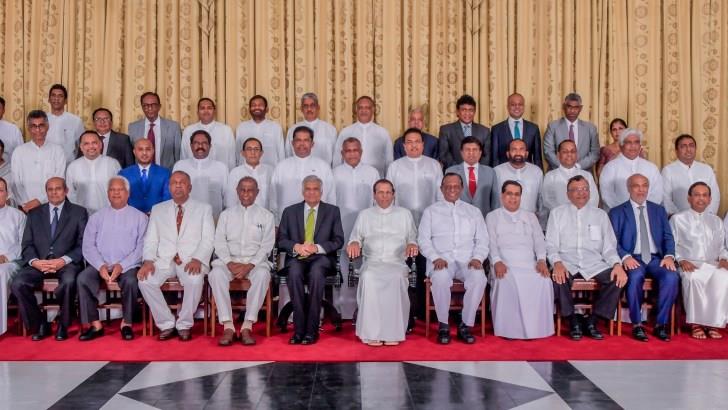
Lankan cabinet reshuffle shows Sirsena will stick to coalition with UNP


On its part, the UNP, led by Prime Minister Ranil Wickremesinghe, has consistently expressed an interest in continuing the coalition till the end of the present parliament in August 2020.
These two factors along with the rationalization of the distribution of portfolios on a 'scientific' basis indicate that the National Unity Government (NUG) headed by Sirisena and Wickremesinghe is determined to make the best of the two years it still has, to fulfill its 2015 election promises.
With two years left for the next parliamentary elections and with the possibility of an indefinite postponement of the Provincial Council elections (due in 2018 and 2019 ) the chances of more MPs defecting to the opposition led by former President Mahinda Rajapaksa have receded.
There was a political context to the defection of 16 MPs earlier. The SLFP as well as the UNP had suffered a crushing defeat in the February 10 local bodies' elections at the hands of the Sri Lanka Podujana Peramuna (SLPP) led by former SLFP chief and Sri Lankan President Mahinda Rajapaksa. Many in the SLFP felt that their future lay not in Sirisena's outfit but in Rajapaksa's or the opposition led by Rajapaksa.
The 16 MPs, including six cabinet ministers and nine junior ministers, had quit in the hope of getting more defectors to bring the coalition government down. But this hope has now vanished. They will now have to cool their heels in the opposition benches for two long years without the perks, privilege and influence that ministerial office would have given them.
And with President Sirisena markedly showing an eagerness to take charge of governmental matters, the NUG could become a functioning government with a Left of Center, populist orientation. That could enhance its chances of gaining popularity.
The possibility of a policy shift happening has been heightened by two factors: One is the mounting pressure on the UNP leader and Prime Minister Wickremesinghe to make his party and administration more Left oriented and populist.
Wednesday's newspapers reported that a group of young UNP MPs lead by Hirunika Premachandra had vowed not to attend meetings with Wickremesinghe till he changes his policies and appoints young functionaries with grassroots contacts.
They have also demanded that populist programs like 'Samurdhi' (an income enhancing scheme for the poor) be made more effective.
President Maithripala SirisenaThe second is the eagerness of Sirisena to use his powers as the Executive President and Head of the Cabinet to change the course of the government's policies and the direction of the administration. Being a Leftist, Sirisena is expected to give the NUG a Left wing and populist orientation which will serve the regime well in the coming elections.
In the past couple of years, Sirisena has been reversing politically untenable decisions of the Prime Minister and his party men. But he has been doing this only fitfully. Therefore, his interventions were ineffective. But from on, he is likely to be more vigilant, consistent and persistent.
Rationalization
The re-distribution of cabinet portfolios on a rational and scientific basis in the latest reshuffle is expected to help the government perform more efficiently than it has in the past three years.
Earlier, the distribution of portfolios did not form a definite pattern, which confused ministers, officials, the public as well as foreign embassies and investors. Ministers felt helpless with some of their functions being handled by other ministries.
Having promised to make a 'scientific' reshuffle, the President gave 'Reconciliation' to Mano Ganeshan who earlier had 'National Co-Existence, Dialogue and Official Languages' but not 'Reconcilation' which is a critical portfolio in the context of the need to bring the minority Tamils and the majority Sinhalese together after a 30 year war.
The war ended in 2009, but ethnic reconciliation is still a far cry.
Prime Minister Ranil WickremesinghePreviously, the Reconciliation portfolio was held by President Maithripala Sirisna and his second in command was AHM Fowzie, a senior minister, but not a Tamil.
Re-induction of Wijedasa Rajapakse
There was only one addition to the cabinet on Tuesday. Wijedasa Rajapakshe, former Justice Minister was brought back into the cabinet as Minister of Higher Education and Culture.
Earlier, he had to resign from the Ministry of Justice because of his controversial remarks which annoyed the international community and a UN Special Rapporteur on torture and alienated the minorities.
When the Special Rapporteur on Torture, Ben Emmerson, stated publicly that "torture in Sri Lanka is on an industrial scale" Rajapakshe bluntly reminded him that US forces had perfected torture in specially built torture camps.
Rajapakshe was also known for his markedly pro-Sinhalese-Buddhist views which were not helpful to reconciliation with non-Buddhist ethno-religious groups. He was unsympathetic to the demand for the release of Tamils held for years on unproven terrorism charges. He alienated the Muslims by saying without proof that 34 Lankan Muslims had left for Iraq and Syria to fight for the ISIS.
However, the coalition partner, United National Party (UNP) to which Rajapakshe belongs, re-inducted him into the cabinet this time as he has clout among the Buddhist clergy which will be helpful in the coming provincial and parliamentary elections between the end of this year and mid 2020.
Wijedasa Rajapakshe,Following the new cabinet ministers and their portfolios:
Other ministerial portfolios remain unchanged.

Legal Disclaimer:
MENAFN provides the
information “as is” without warranty of any kind. We do not accept
any responsibility or liability for the accuracy, content, images,
videos, licenses, completeness, legality, or reliability of the information
contained in this article. If you have any complaints or copyright
issues related to this article, kindly contact the provider above.


Comments
No comment