


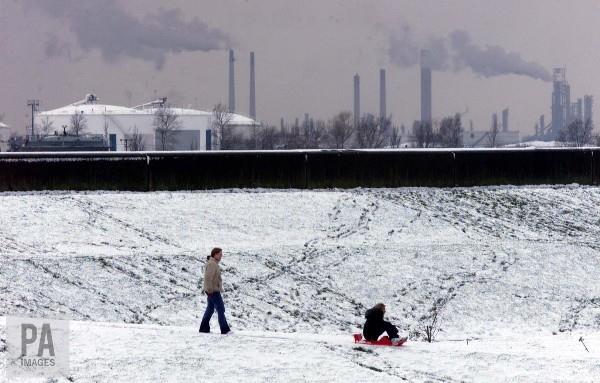
Extreme weather tests UK gas security to the limit


More than 80% of UK households use gas to heat their homes so the industry has to handle . British weather is notoriously unpredictable and experiences fluctuations throughout the year. This requires flexible energy supply, especially when extreme weather events hit, .
Historically, flexible supply came from simply producing more from the North Sea, but due to falling production that option has gone. Instead, flexibility today comes from four sources: from Norwegian offshore production that is delivered by pipeline directly to the UK, from domestic storage facilities, from the UK's three liquefied natural gas (LNG) terminals and gas from Europe via . What gas comes from where depends on the market price – in the UK, Europe and globally – and the willingness of those that own the gas to sell it.
No surprises hereThe industry that things could get difficult. The reason being that back in June last year Centrica, the UK energy group that owns British Gas that it was closing its long-term storage facility at Rough, a depleted gas field off the Yorkshire coast. Technical problems were making it increasingly costly to maintain. But it was the UK's largest gas storage site.
Even before then, the UK was , with a capacity equivalent to 5.9% of total consumption in 2016. In some countries, including Germany, France and Italy, storage covers around 20% of demand. With the Rough facility gone, the UK is left with 1.4bcm of medium range storage – equivalent to 1.8% of 2016 consumption. This gets filled and emptied many times over the course of the winter. But, in an emergency such as this, it is quickly emptied and won't refill while prices are high.
Most British households are powered by gas.Until recently the government did not seem phased by the closure of Rough, despite back in November to review the situation. , it is now thinking again. With limited storage, the UK is dependent on sufficient gas being in the LNG tanks and on being able to get more gas from Norway and continental Europe. But there are physical limits on the pipelines that carry that gas.
a combination of a fire at the Baumgarten gas hub in Austria, technical problems in the North Sea and with the interconnector pipelines that enable imports from northwest Europe, and congestion on the National Transmission System (NTS) operated by National Grid, all resulted in shortage and a short-lived spike in the UK's gas price. Things soon rectified themselves and it was back to business as usual.
This time is differentBut, this time is different, as a prolonged period of cold weather right across Europe is resulting in a surge in gas demand, that is projected to .
The surge in demand in the UK also puts additional pressure on National Grid to move gas around the system. Back in December, congestion limited the ability of the interconnectors to supply gas. At present, the LNG tanks are , thanks to recent deliveries from Qatar and Russia, and gas is flowing from all three terminals. But it takes two weeks for an LNG tanker to get to its Welsh terminal from Ras Laffan in Qatar. Thus, the UK has to work with what it has at the moment.
With demand in the UK surging to more than 400mscm a day (compared to ), a loss of capacity from any source of flexible supply, due to technical problems or an inability to attract sufficient gas from European markets, can lead to a supply emergency like the one just seen. If there were also technical failures on what is an ageing infrastructure, a prolonged cold spell could make things difficult.
The EU has introduced new policies in relation to gas security, including a ' which requires member states to help one another in an emergency. What happens if the UK leaves the ? Equally, what happens in Ireland, which is dependent on the UK for its security of supply? It's yet another Brexit issue to contend with. If not, a cold shoulder from Brussels could end up being just as damaging as the Beast from the East.


Legal Disclaimer:
MENAFN provides the
information “as is” without warranty of any kind. We do not accept any
responsibility or liability for the accuracy, content, images, videos,
licenses, completeness, legality, or reliability of the information
contained in this article. If you have any complaints or copyright issues
related to this article, kindly contact the provider above.


Comments
No comment