


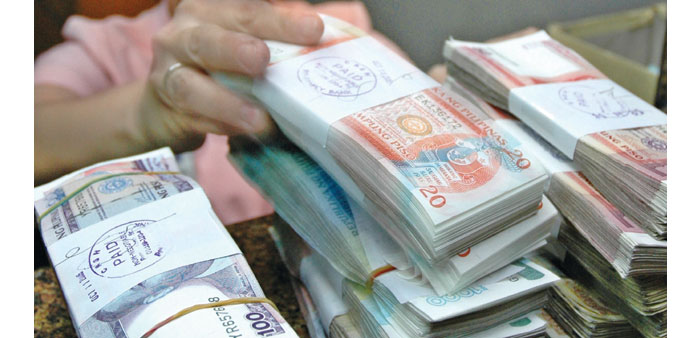
Philippine budget gap narrows in 2014: DOF


(MENAFN- Gulf Times) The Philippine government's budget gap in full-year 2014 narrowed from a year earlier and resulted in a lower-than-target deficit to gross domestic product (GDP) ratio, the Department of Finance (DOF) reported.
Data released by the DOF showed that the government registered a 73.1bn peso fiscal deficit in full-year 2014, down 55% or P91.0bn from the P164bn gap in 2013.
Relative to the size of the economy, the agency said the full-year fiscal deficit plunged to 0.6% of GDP, lower than both the 2% program and the 1.4% recorded in the previous year.
In December alone, the deficit for the month of December 2014 was recorded at P46.3bn down 12% from P52.6bn deficit a year earlier.
The government said that its fiscal performance last year indicates that the country continues to stand on firm fiscal footing because of the reforms it has implemented, but an analyst said the government continues to be the "missing link" for economic growth.
In terms of primary budget, the data showed that the government recorded a P248.1bn primary surplus for 2014, exceeding the government's target of P86.4bn and better than the P159.4bn primary surplus in 2013.
Primary budget figures exclude interest payments on foreign and domestic debt issues recorded during the month as an indicator of the management of expenditures apart from debt servicing. A primary budget surplus indicates that the government collected more revenue than it spent for projects and programs other than debt service.
Total revenue for the year amounted to P1.908tn, growing by 11% or P192.4bn year-on-year. The full-year collections, which comprised P1.72tn in tax revenues and P188.1bn from non-tax sources, were nevertheless 5% lower than the government's 2014 revenue target.
According to the DOF data, collections by the Bureau of Internal Revenue (BIR) in 2014 reached P1.334tn, 10% higher than last year's level, while the Bureau of Customs (BOC) collections increased 21% year-on-year to P369.3bn.
"While thetn peso-strong BIR continues to grow by double digits for the 4th consecutive year, the BOC now leads all other national government agencies in terms of growth," Purisima said.
The finance chief said that the double-digit revenue growth registered by the BOC in 2014
shows how change is taking root in the bureau and delivering real gains.
"We expect to continue this steady uptrend as we institutionalise good governance in our revenue agencies," he said. Meanwhile, total Bureau of Treasury income for the year rose 15% to P93.4bn due to the agency's proactive cash and investment management as reflected in the Bond Sinking Fund (BSF) and national government deposits income, as well as dividends on shares of stocks.
Collections from other offices, however, narrowed by 2% to P111bn from 2013.
"Robust revenue performance proves one simple, undeniable fact: reform works," Purisima said.
Despite increasing some 5% from 2013, government disbursements continued to lag, falling 13% short of the government's programmed goal.
Disbursements by the national government in 2014 amounted to P1.981tn, the DOF reported.
The DOF further reported that interest payments for the year declined slightly by 1% to P321.2bn from P323.4bn in 2013.
"Institutionalizing reforms across all agencies translated into favorable numbers that bode well for the Filipino people. Time and again, we have proven how this government is forward-facing and actively engaged in building our prosperous future," Purisima said.
At least one analyst, however, took a rather less congratulatory view, suggesting that the government continues to be the 'missing link' in the country's growth story as it struggles to keep up with the rapidly growing private sector.
"The fiscal picture has two faces," Nicholas Antonio Mapa, associate economist at the Bank of the Philippine Island said. "On one hand, you have improving collections, albeit still short of their targets for the year. On the other hand, you see a government inept in spending the funds they collected from the taxpayers. Deficit to GDP reached only 0.6%, less than a third of their own target of 2.1% of GDP." "Better fiscal numbers aren't necessarily a good thing if it comes at scrimping on spending, at a time when the government needs to invest to build capacity," he concluded.

Legal Disclaimer:
MENAFN provides the
information “as is” without warranty of any kind. We do not accept
any responsibility or liability for the accuracy, content, images,
videos, licenses, completeness, legality, or reliability of the information
contained in this article. If you have any complaints or copyright
issues related to this article, kindly contact the provider above.


Comments
No comment