


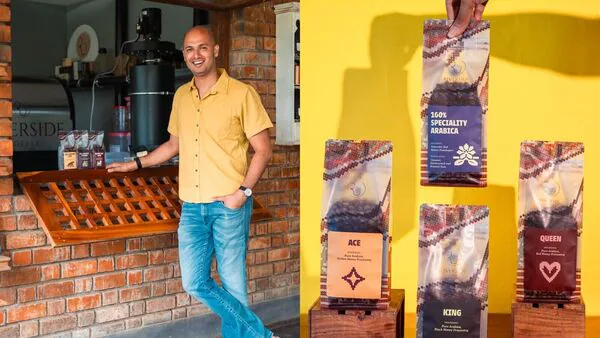
Man Quits Job To Build Brand Out Of More Than A Century-Old Coffee Estate Of His Family, Earning ₹2 Cr Annual Revenue


Riverside Coffee began in 1898 with Devaya's great-great-grandfather, who moved to a part of the family's larger estate in Coorg, Karnataka, to look after its paddy fields. A disagreement with his brother led him to settle at the farthest end of the property, Devaya shared during a chat with Livemint.
Introducing D2C modelKeeping coffee at the centre of the business, Devaya's ambition was to change how their family business was operating. Having worked in the wine industry, he had seen how growers could build a brand around their own produce rather than selling it to someone else in the supply chain.
“I remember looking at that model and thinking: we already have our own coffee estate, so why couldn't we do the same with coffee?” he said.
Beyond cultivation, he wanted to get involved in processing, roasting, branding, and selling the final product. Devaya explored what he described as an estate-to-cup model, drawing inspiration from the vineyard-to-bottle approach.
Also Read | Gurugram coffee startup crosses ₹1 cr in revenue, plans 100+ stores by 2027 Initial challengesThe transition meant moving away from a foolproof and predictable business model.
Building a consumer-facing brand required significant investments in infrastructure, processing, and marketing, but with no guaranteed return.
“My father still occasionally asks the very practical question: 'If we can sell this coffee today and know exactly what we'll earn, why are we holding it back?'” Devaya said.
Currently, the brand is offering its products through direct sales, wholesale and online retail, alongside a quaint café and visitor experiences at the estate.
Selling directly to cafés and consumers comes with its own challenges. Buyers may have different taste preferences, budgets, equipment and brewing methods. To compete in today's growing coffee market in India, one needs to do much more than just marketing, he said.
“A bean can taste completely different depending on the machine, grind, water, recipe or brewing method,” Devaya said.“If something is not tasting right at a café, you cannot simply say, 'the coffee is good'," he explained. To solve this problem, the company likes to educate buyers about coffee varieties, brewing techniques and flavour profiles. It has also explored Excelsa, adding it to a sampler alongside Arabica and Robusta in this journey.
Also Read | 23-year-old quits Morgan Stanley to start company, reveals cold email strategy Revenue breakupDevaya reveals that roughly 58% of the business's monthly revenue comes directly from coffee sales, while the remaining 42% comes from other channels including wholesale, retail, cafe sales, estate experiences and miscellaneous sources. online retail another 17%.
“Our intention was to see how much more of the value around the coffee the estate itself could participate in.”
Effects of climate changeLike other coffee growers, Riverside is also dealing with increasingly unpredictable weather in the country. The estate experienced a rainfall shortage this year, following near-ideal conditions last year and excessive rain the year before.
“Coffee is an extremely sensitive crop. Too much rain can be a problem, too little rain can be a problem; the same applies to heat and sunlight,” the fifth-generation owner said.
Also Read | South India pins hope on northeast monsoon for rainfall relief“What worries me most is not simply that the climate is getting warmer; it is that the seasons we once relied on are becoming harder to rely on,” he said.
For now, the brand remains focused on investing in marketing and distribution rather than expanding through physical locations, he concluded.

Legal Disclaimer:
MENAFN provides the
information “as is” without warranty of any kind. We do not accept
any responsibility or liability for the accuracy, content, images,
videos, licenses, completeness, legality, or reliability of the information
contained in this article. If you have any complaints or copyright
issues related to this article, kindly contact the provider above.


Comments
No comment