


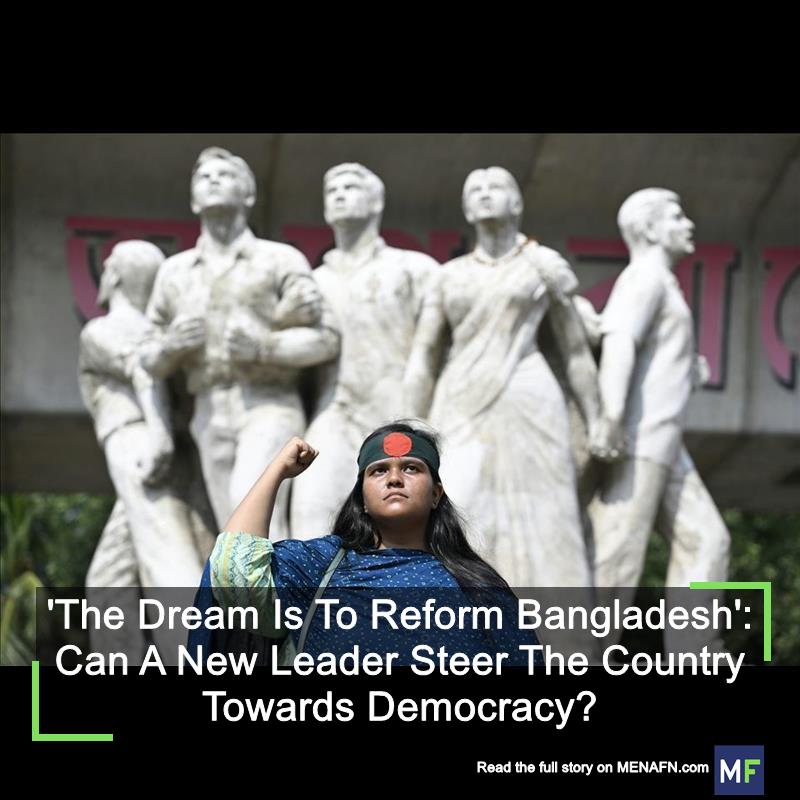
'The Dream Is To Reform Bangladesh': Can A New Leader Steer The Country Towards Democracy?


After Hasina left the country, the army took over and swiftly established an interim government to steer Bangladesh towards free and fair elections within three months.
Amid hopes for genuine societal reform , however, people are still wary. Is the three-month timeline sufficient to transform a politically fraught Bangladesh into a substantive democracy that can resist sliding back into autocracy?
Bangladesh at a critical junctureFor the past 15 years, heavy-handed, one-party rule in Bangladesh has squeezed opposition parties out of the political system and deprived citizens of true democracy.
The breaking point came when nationwide, student-led protests against an unfair government job quota transformed into a defiant movement to oust Hasina.
Protesters celebrate beside a defaced portrait of Prime Minister Sheikh Hasina after news of her resignation on August 5. Fatima Tuj Johora/AP
The 84-year-old Nobel laureate and entrepreneur Muhammad Yunus has now been appointed head of the transitional government , bringing much-needed credibility and economic expertise to a fragile moment.
The interim government also includes rights activists, professors, lawyers, former government officials and prominent members of Bangladesh's civil society. Promisingly, it includes two 26-year-old student leaders – Nahid Islam and Asif Mahmud. This move elevates young voices to a position of political decision-making.
Previously sidelined parties are getting back in the game , as well, such as the Bangladesh Nationalist Party (BNP) and Islamist Jamaat-e-Islami party. The public, however, has little appetite for these old players.
And the country that the interim government inherits is far from stable. High inflationary pressures, endemic corruption and the undermining of democratic institutions have left Bangladesh in an economic mess .
On the security front, Hasina's departure has unleashed a wave of violence, with attacks on Bangladesh's Hindu minority population, in addition to looting and arson attacks around the country.
Yunus now shoulders the weight of a nation's hopes, facing monumental expectations of uniting a fractured society, restoring the economy and reestablishing law and order.
Muhammad Yunus, surrounded by protest student leaders, after arriving in Dhaka on August 8. Monirul Alam/EPA Caretaker government: toothless or transformative?
The interim government will likely try to steer the country towards significant constitutional reform, either by drafting a new constitution or amending the existing one .
But the very existence of an interim government – let alone exercising power to amend the constitution – is unconstitutional in and of itself.
Following the 15th constitutional amendment enacted in 2011, the current constitution no longer provides for caretaker governments . This creates a legal paradox , even though the interim government's role in addressing the current crisis is widely seen as necessary.
Another critical decision facing the caretaker regime is when to hold elections . The constitution mandates a three-month deadline, but if the interim government rushes into an election, it likely won't begin to resolve any of the underlying issues that led to the protests.
Legal experts have recommended delaying the elections to allow more time for essential political reforms.
One of the most vital tasks is restoring the independence of vital institutions, including the election commission.
Under Hasina, the parliament acted merely as a rubber stamp, the civil service and judiciary were deeply politicised and the media and civil society were tightly controlled. While some institutions may quickly thrive in a more open environment, others will bear the scars of the past for years.
Amtul Chowdhury, a 28-year-old lawyer in District and Session Judges Court in Chittagong, told me the interim government shouldn't be bound by the existing constitution. She views it as a problematic document in need of reform – a task the caretaker government lacks the parliamentary power to enact.
According to Chowdhury, more time is required to create space for new, visionary political parties to emerge.
University students shouting slogans during a protest in Dhaka on July 31. Rajib Dhar/AP Looking forward
Bangladesh has seen this cycle of political turmoil before – autocrats or governments forced out by popular uprisings, only to be replaced by regimes that ultimately fail to meet public expectations.
What is different this time around is the student-led movement was not carried out under the banner of a specific political party; its success was due to the neutrality and participation of all people.
As a student protester in the capital Dhaka told me,
Much of the transition to a substantive democracy will rely on the powerful sense of solidarity, hope and civic consciousness that the country's youth has been embracing.
However, the challenges facing this generation are immense. The interim government, and any future leadership, must address the growing inequality in society and lack of employment opportunities for young people.
With nearly 40% of the population under 18 , there is a pressing need to turn this demographic into an asset rather than a burden. Continued investment in the country's youth is also essential for the government to move away from its past autocratic tendencies. And there's no doubt that young people, given the chance, will give back to their country.
As my niece Arnaz Tariq, who is a 20-year-old Bangladeshi student at the University of Southern Mississippi in the US, told me:
-
Bangladesh
Muhammad Yunus
World news
Bangladesh protests
Sheikh Hasina


Legal Disclaimer:
MENAFN provides the
information “as is” without warranty of any kind. We do not accept
any responsibility or liability for the accuracy, content, images,
videos, licenses, completeness, legality, or reliability of the information
contained in this article. If you have any complaints or copyright
issues related to this article, kindly contact the provider above.


Comments
No comment