


Russia PM estimates economy shrank by 2 in Q1


(MENAFN- Arab News) MOSCOW: Prime Minister Dmitry Medvedev has estimated that the Russian economy shrank by two percent in the first quarter due to sanctions pressure and low oil prices.
If confirmed that would be the first quarterly contraction since 2009. Medvedev warned lawmakers the situation could worsen further in contrast to President Vladimir Putin who said last week the worst of the economic crisis had passed.
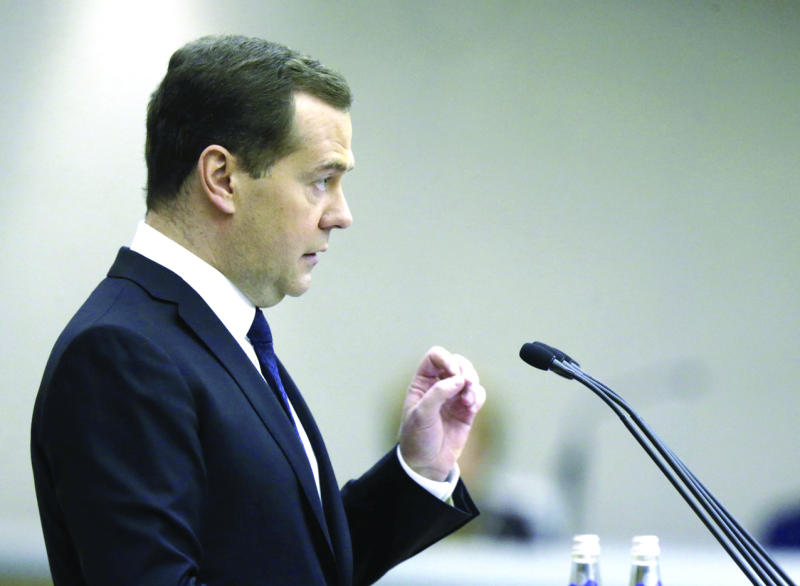
'Negative trends continue this year' following the crisis of the ruble national currency in late 2014 said Medvedev while presenting a government report to parliament.
'Between January and March GDP contracted about two percent.'
Last year the Russian ruble collapsed sending inflation into double digits. Prices of food skyrocketed exacerbated by Russia's embargo on food imports from the European Union.
On Friday the state statistics service said that in March foreign trade was down more than 26 percent while real wages fell 9.3 percent and inflation picked up by 16.9 percent compared with the same period last year.
Russia's central bank predicted the economy could shrink by as much as four percent in 2015 if oil remains around $50 per barrel.
The crunch has forced the government to dip heavily into its reserves and publicly ponder the sensitive issue of raising the retirement age for the first time since the 1930s.
Analysts with the Higher School of Economics last week said that the shrinking of Russians' purchasing power will continue for at least a year accompanied by growing unemployment and bankruptcies and a decline in social welfare from budget cuts to health and education.
Medvedev said that the crisis robbed Russia of billions of euros but argued that since it was brought on by Western sanctions imposed over Russia's annexation of Crimea it could not be avoided.
Russia last March annexed Ukraine's Black Sea peninsula after deploying special forces there and overseeing a controversial referendum that supported Moscow.
'Adding on Crimea affected our economy' Medvedev said.
'Experts say that the overall damage to Russia was 25 billion euros that is 1.5 percent of the GDP and in 2015 it could be several times that.'
But the decision to annex Crimea was 'the only one possible and we all... supported it knowing the possible consequences' said the prime minister.
He said 'in terms of intensity the latest wave of sanctions could be the strongest' that the West had imposed on Moscow in either the Soviet or post-Soviet period.
'Looking at the situation as a whole it is stabilising but we should not have any illusions: these are not just short-term crisis events' he said.
'If external pressure intensifies and oil prices stay at extremely low levels for a long time we will be forced to develop in a different economic reality which will fully test all of us.'
'Every country's history has a moment from which begins a new era' he said.
'Clearly 2014 became this for modern Russia' he said comparing the significance of Crimea to the fall of the Berlin Wall and the reunification of Germany.
'Unprecedented political and economic pressure is payback for our position' he said.
'Could our country have avoided this economic scenario? The answer is simple: it could not.'
If confirmed that would be the first quarterly contraction since 2009. Medvedev warned lawmakers the situation could worsen further in contrast to President Vladimir Putin who said last week the worst of the economic crisis had passed.
'Negative trends continue this year' following the crisis of the ruble national currency in late 2014 said Medvedev while presenting a government report to parliament.
'Between January and March GDP contracted about two percent.'
Last year the Russian ruble collapsed sending inflation into double digits. Prices of food skyrocketed exacerbated by Russia's embargo on food imports from the European Union.
On Friday the state statistics service said that in March foreign trade was down more than 26 percent while real wages fell 9.3 percent and inflation picked up by 16.9 percent compared with the same period last year.
Russia's central bank predicted the economy could shrink by as much as four percent in 2015 if oil remains around $50 per barrel.
The crunch has forced the government to dip heavily into its reserves and publicly ponder the sensitive issue of raising the retirement age for the first time since the 1930s.
Analysts with the Higher School of Economics last week said that the shrinking of Russians' purchasing power will continue for at least a year accompanied by growing unemployment and bankruptcies and a decline in social welfare from budget cuts to health and education.
Medvedev said that the crisis robbed Russia of billions of euros but argued that since it was brought on by Western sanctions imposed over Russia's annexation of Crimea it could not be avoided.
Russia last March annexed Ukraine's Black Sea peninsula after deploying special forces there and overseeing a controversial referendum that supported Moscow.
'Adding on Crimea affected our economy' Medvedev said.
'Experts say that the overall damage to Russia was 25 billion euros that is 1.5 percent of the GDP and in 2015 it could be several times that.'
But the decision to annex Crimea was 'the only one possible and we all... supported it knowing the possible consequences' said the prime minister.
He said 'in terms of intensity the latest wave of sanctions could be the strongest' that the West had imposed on Moscow in either the Soviet or post-Soviet period.
'Looking at the situation as a whole it is stabilising but we should not have any illusions: these are not just short-term crisis events' he said.
'If external pressure intensifies and oil prices stay at extremely low levels for a long time we will be forced to develop in a different economic reality which will fully test all of us.'
'Every country's history has a moment from which begins a new era' he said.
'Clearly 2014 became this for modern Russia' he said comparing the significance of Crimea to the fall of the Berlin Wall and the reunification of Germany.
'Unprecedented political and economic pressure is payback for our position' he said.
'Could our country have avoided this economic scenario? The answer is simple: it could not.'

Legal Disclaimer:
MENAFN provides the
information “as is” without warranty of any kind. We do not accept
any responsibility or liability for the accuracy, content, images,
videos, licenses, completeness, legality, or reliability of the information
contained in this article. If you have any complaints or copyright
issues related to this article, kindly contact the provider above.


Comments
No comment