

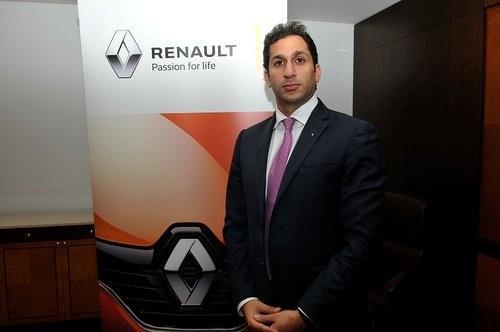
Oman- Business Interview: 'GCC car market expected to stabilise in 2018'


In an exclusive interview with Muscat Daily, Haidamous said he believes car sales in the GCC region will stabilise this year and the market could see some growth from third quarter of 2018. He also talked about Renault's market share, targets and the future of electric vehicles in the region.
Car sales in the GCC, including Oman, have been falling for the past few years, however, many people are hoping for a turnaround this year. What do you say?I believe sales in the GCC region will be little slower in the first quarter as two of the region's biggest markets, Saudi Arabia and UAE are moving towards the implementation of value added tax (VAT). However, things are moving in the right direction and I expect the market to stabilise in 2018. Overall car sales in the region could see some positive movement from the third quarters of the current year.
Car market in Oman and other GCC countries are mainly dominated by Asian brands due to pricing advantage they have. How confident you are about the success of your brand in this market?I am very confident about the future of Renault in the GCC. I admit that the GCC market, including Oman, is currently dominated by four Asian brands, two Japanese and two Koreans. Currently, these four companies together accounts for 60 per cent of the total car sales in the GCC. Renault has something more to offer to its customers. We offer a unique European design, which according to us, is a big advantage. Second important thing is the features, we provide in our cars such as easy trunk access, easy parking access, and multimedia screen that gives a feeling of a smart car. And I believe even with these advance features, we are still very competitive in pricing. We are also launching a new line of products to widen our product offering, and that will help us to gain market share in the future.
What is Renault's current market share in the GCC and what are your short term targets?In the GCC region, currently we have around four per cent market share. Our aim is to reach to six per cent market share by 2022. So, effectively we are seeking a 50 per cent increase in our market share. This market share in the GCC region doesn't reflect true capabilities of Renault Group. If you look at other markets where we operates we are very strong there. In Europe, we have around 10.8 per cent market share, we are also considered as the second most popular brand in automotive market in Europe. Some Asian brands, which are dominating here didn't even have one per cent market share in Europe. Similarly in Eurasia, which includes countries such as Russia, Turkey and Romania, our market share is 24 per cent. So it is just a matter of time till we get our right share in this region.
Don't you think during economically troubled times, most people will prefer cheaper Asian cars rather than opting for expensive European cars?General perception is that European cars are more expensive than Asian cars. In our business perception is considered as realty. But there is a catch here, we know our price positioning is very competitive. We are offering much more to our customers in terms of design, features, quality and after sales services. And I believe, when you do right things, no matter what the perception is, you will be successful in the long run.
We are sure about our capabilities and that is why we are making investments at a time when no other car maker is willing to put money in the region. It might take some time for us to reach a satisfaction level, as we are competing against some cars brands, who have been present in the GCC market for over 70 years. We started our operations in the GCC in year 2000 only. We are still a very young brand in the region. So, we are not worried rather we are very hopeful that soon perceptions about our cars will change due to the efforts taken by us.What special measures are you planning to take in future to achieve targeted market share in the region?
Future would definitely be ours. If you take into account the potential and the performance of Renault cars globally, and the product line we have along with the huge improvement done on the quality, customer satisfaction and after sales services, It would be enough to push our market share up. We also have a strong action plan taken on increasing consumer satisfaction through after sales services. Moreover, we are making huge investments on improving the brand identity through a strong marketing action plan, which includes sponsoring popular events like 'The Voice Arabia'.Renault's natural performance is not reflected in the current market share in the GCC region. Renault's average market in all markets it operates, except North America, is around eight per cent. I don't see any reasons with the partners, energy, passion and commitment, we have, our market share is going to remain lower than the global average.
Many car makers are shifting focus from internal combustion engines to electric vehicles. Do you also believe electric vehicles would replace traditional cars in future?Customer generally doesn't care much whether the engine is petrol or electric. It is the regulators who care about these things as they wants to reduce CO2 emissions and wants to cut pollution levels. Regulators in many countries are supporting electric cars with incentives and infrastructure support system such as charging stations. This kind of support doesn't exist here at the level you could see in China and Europe.
But, it is sure that electric car is the future. And there is a trend, which is visible globally; it is the decline in battery prices. Most people are expecting battery prices to fall by over 30 per cent by 2022. And then the prices of electric cars without any support from authorities would be equal to the prices of internal combustion cars. Therefore, it will take a while to reach that stage. Until then, electric cars need to be supported by incentives and infrastructure support.Let me tell you one thing clearly, Renault is ready for electric cars. We were the first one to introduce these cars in the GCC market. We are the leader in electric vehicle segment in terms of technology, and driving range, distance a vehicle can cover in a single charge. Renault ZOE has 25 per cent market share in Europe. Globally, we reported 40 per cent increase in sales of electric vehicles in 2017 compared to 2016.
Do you have plans to launch more electric vehicle brands in the GCC region, particularly Oman?If a person wants to purchase ZOE cars, we will be very happy to make the car available here. But the problem is neither the technology nor the availability, there is still not any spontaneous demand for the electric vehicles in the country due to lack of charging facilities. Coming to the question of introducing electric vehicles in the GCC, we have already introduced Renault ZOE here (in UAE). In Europe and China, people are talking about one charging station for every car keeping in mind the expected rise in number in future, whereas in Oman very recently the government opened the first charging station. Therefore it will take some time before electrical vehicles become a mass market product here in Oman and other GCC markets.
Renault has a complex arrangement of business with Nissan and Mitsubishi? Can you elaborate on the structure of business Renault has with other rival auto majors like Nissan and Mitsubishi?In 1999, Renault bought 45 per cent stake in Nissan, and Carlos Ghosn, who was at number two position in Renault, took the position of CEO of Nissan also. Later Mitsubishi, another Japanese car joined the alliance. Renault along with Nissan and Mitsubishi, became the world's largest automotive company having capacity to sell over 10.6mn cars annually. It all started in 1999 when Renault decided to take control of Nissan. Ghosn is still chairman and chief executive officer of Renault. He is also holding the position of chairman in Nissan and Mitsubishi. And he is also holding the position of chairman in the alliance between three companies.

Legal Disclaimer:
MENAFN provides the
information “as is” without warranty of any kind. We do not accept any
responsibility or liability for the accuracy, content, images, videos,
licenses, completeness, legality, or reliability of the information
contained in this article. If you have any complaints or copyright issues
related to this article, kindly contact the provider above.
Comments
No comment