




403
Sorry!!
Error! We're sorry, but the page you were looking for doesn't exist.
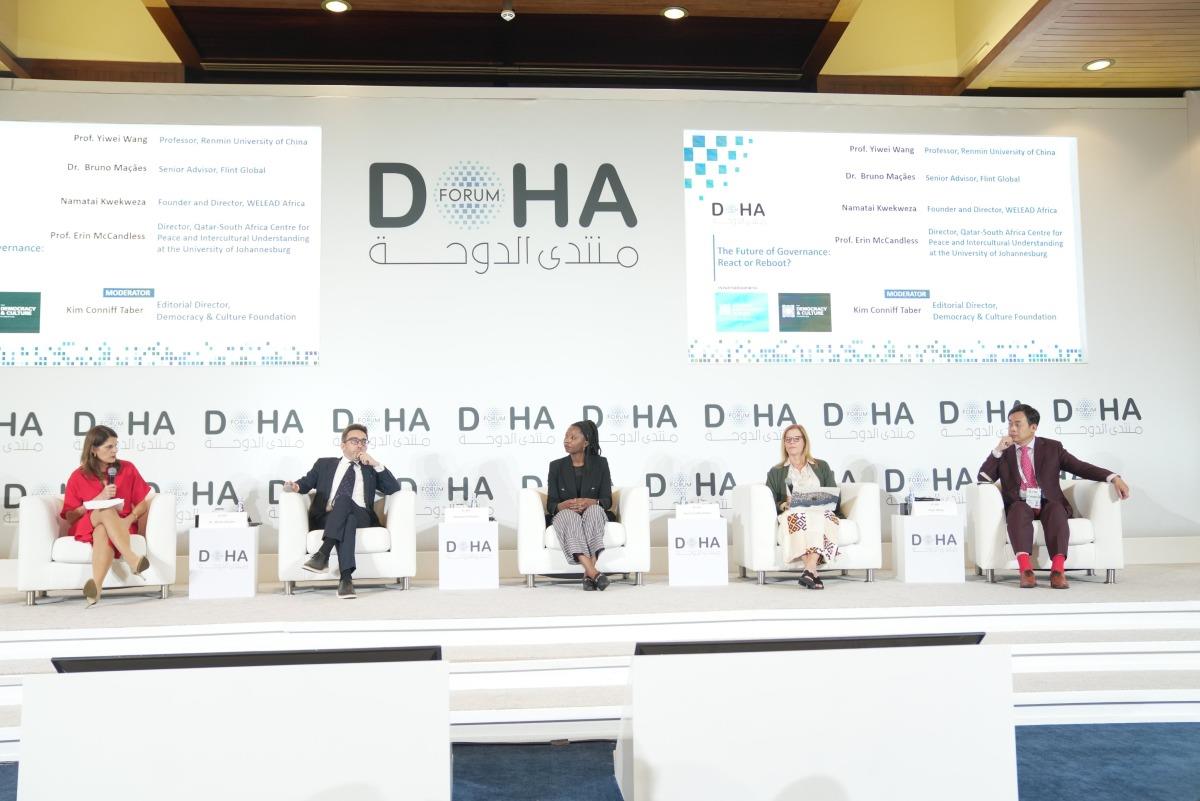
Experts Explore Governance Future Amid Geopolitical Disorder
(MENAFN- The Peninsula)
Joel Johnson
|
The Peninsula
Doha, Qatar: The final day of the Doha Forum 2025 concluded with a provocative discussion on whether the world's current governance systems can be repaired or must be fundamentally redesigned for a rapidly changing global era.
A panel session entitled, 'The Future of Governance: React or Reboot?' brought together leading thinkers and diplomats, including Dr. Bruno Maçães, Senior Advisor at Flint Global; Namatai Kwekweza, Founder of WELEAD Africa; Prof. Erin McCandless, Director of the Qatar–South Africa Centre for Peace and Intercultural Understanding; and Prof. Yiwei Wang of Renmin University of China.
Their discussion unfolded against a backdrop of rising geopolitical tensions, technological disruption, declining trust in public institutions, and increasing scepticism around traditional models of liberal democracy.
One of the central questions raised during the dialogue was whether liberal democracy has reached its limits. Prof. Erin McCandless challenged the assumption that democracy itself is broken, arguing instead that its implementation has undermined its legitimacy.
Read Also-
QFFD advances global development through signing of agreements exceeding QR2.016bn
Architect unveils vision for new MoFA headquarters
Qatar's First Polo tournament marks a new sporting milestone: Qatar Polo Club DG
“Liberal democracy is something that is dead or failed, right?” she said.“I would argue it's under pressure not because of the core value but because of the way it has been manipulated and implemented in ways that project hypocrisy and double standards.”
She noted that democratic systems have increasingly failed to deliver meaningful outcomes, deepening polarisation and frustration among citizens.
Countering the notion that democracy is a Western invention, Dr. Bruno Maçães emphasised that democratic norms predate modern Western political systems.
“Liberalism and democracy are universal values that are not invented by the West,” he said.“If you study other civilisations, you find very robust forms of democracy in their human forms.” He pointed to village governance traditions in India and pastoral democratic systems in Africa, where decision-making was dispersed and flexible.
“In a nomadic society, it's very easy to build a democracy, because whoever doesn't agree with the decisions can walk away with the cattle,” he remarked, which was a line that drew both reflection and smiles from the audience.
Expanding the discussion beyond ideology, Prof Yiwei Wang argued that governance debates must also consider material inequality.“Today, more than 600 million people cannot have access to electricity,” he said.
“So when you talk about sovereignty, and you don't have electricity, how can you talk?”
With over one billion people lacking Internet access, Wang warned that any future governance model must prioritise access, infrastructure and technological equity, not just legal or constitutional form.
“It's also the capacity equality, not just the equality of ego, that is important,” he added. The discussion also touched on whether artificial intelligence could eventually assist or even lead governance systems. While views differed, panellists agreed the world is at a crossroads as reforming outdated systems may no longer be sufficient.

Legal Disclaimer:
MENAFN provides the
information “as is” without warranty of any kind. We do not accept
any responsibility or liability for the accuracy, content, images,
videos, licenses, completeness, legality, or reliability of the information
contained in this article. If you have any complaints or copyright
issues related to this article, kindly contact the provider above.
Most popular stories
Market Research

More Story




Comments
No comment