







403
Sorry!!
Error! We're sorry, but the page you were looking for doesn't exist.
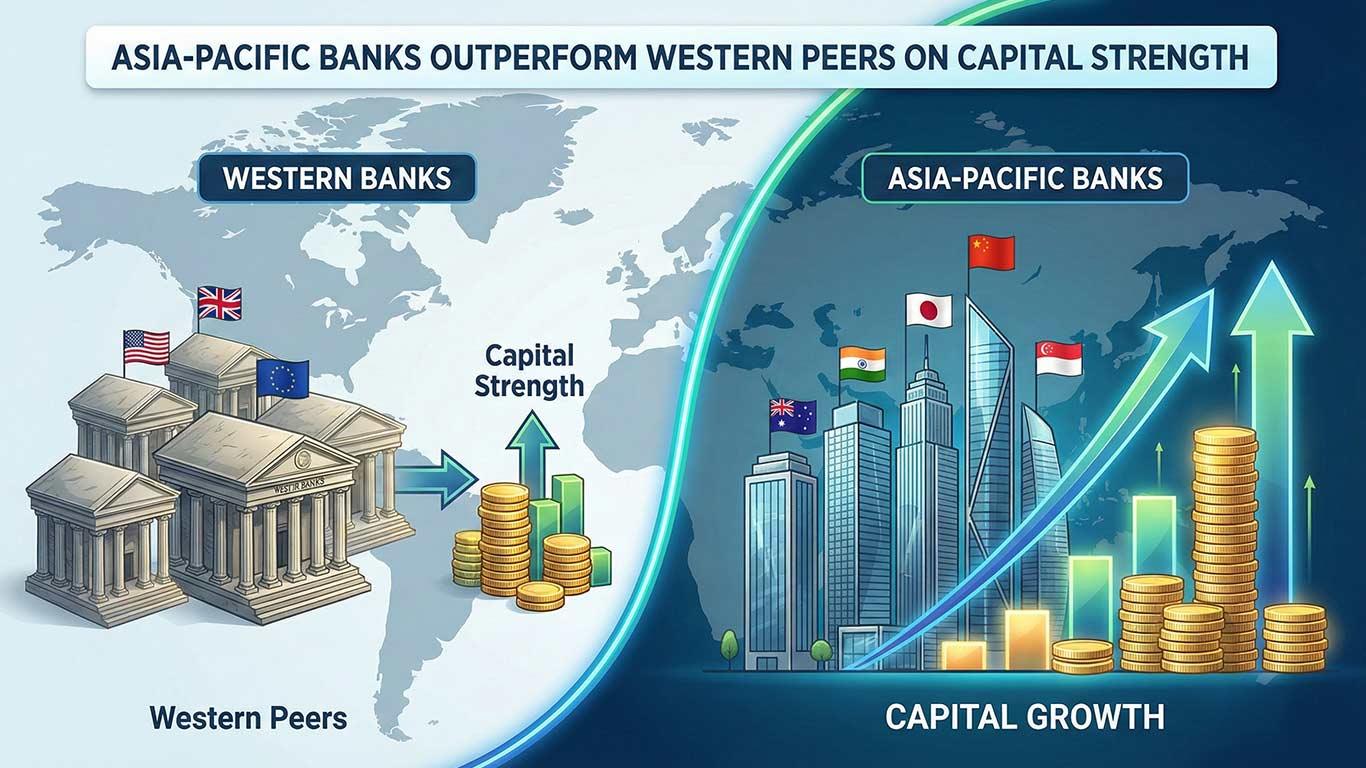
India & Asia-Pacific Banks Outperform Western Peers On Capital Strength: Moody's
(MENAFN- KNN India)
New Delhi, Dec 8 (KNN) Banks in the Asia-Pacific region, including India, maintain stronger capital positions than their counterparts in the United States and Western Europe, according to Moody's latest survey report.
Robust Capital Buffers and Regulatory Oversight
The survey highlighted that the region's largest banks generally sustain robust capital buffers under prudent regulatory supervision, reported ANI.
Risk-weighted asset (RWA) densities, which adjust for credit risk, vary across the region and reflect underlying asset quality and credit losses over the past decade. Higher RWA densities indicate a larger proportion of riskier assets.
India's Private Banks Leading on Capital Adequacy
Moody's emphasised the strength of India's large private sector banks, noting high Common Equity Tier 1 (CET1) capital adequacy and leverage ratios.
These banks have benefited from strong internal capital generation, outpacing RWA growth, and the ability to raise equity from capital markets when needed.
CET1 represents core capital-including common shares and retained earnings-and serves as the first line of protection against losses.
As of end-2024, average CET1 ratios stood at 18.0 per cent for large banks in Hong Kong, 14.7 per cent in India, and 14.5 per cent in Korea, compared with 13.5 per cent for the four largest US banks and 13.8 per cent for the top six Western European banks.
While India's private banks show strong capital metrics, government-owned banks remain weaker in both capital adequacy and leverage ratios.
RWA Densities and Regulatory Reforms
Higher RWA densities in India, Vietnam, and some Chinese banks were linked to the standardised regulatory approach, which applies fixed risk weights rather than internal risk-based models.
Indian regulators plan to allow banks to transition to the Internal Ratings-Based (IRB) approach by 2028, expected to reduce RWA densities if successfully implemented.
The Indian sample included State Bank of India, Axis Bank, ICICI Bank, and HDFC Bank, collectively representing about 50 per cent of system assets.
Survey Coverage and Conclusion
The survey covered 35 banks across eight key Asia-Pacific banking systems, representing roughly 75 per cent of total assets of rated banks in these markets.
Moody's concluded that Asia-Pacific banks are generally well-capitalised and have the flexibility to raise additional equity if required, positioning them to withstand potential shocks better than US and European peers.
(KNN Bureau)

Legal Disclaimer:
MENAFN provides the
information “as is” without warranty of any kind. We do not accept
any responsibility or liability for the accuracy, content, images,
videos, licenses, completeness, legality, or reliability of the information
contained in this article. If you have any complaints or copyright
issues related to this article, kindly contact the provider above.
Most popular stories
Market Research

More Story






Comments
No comment